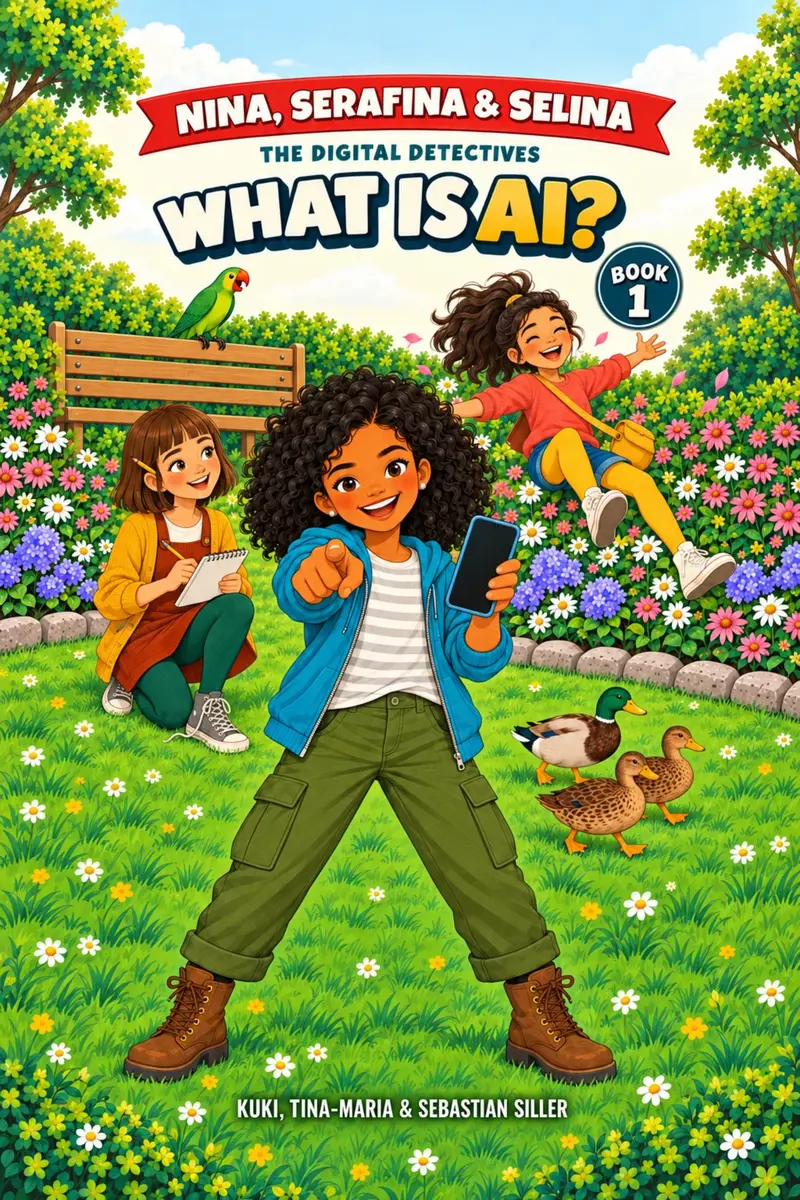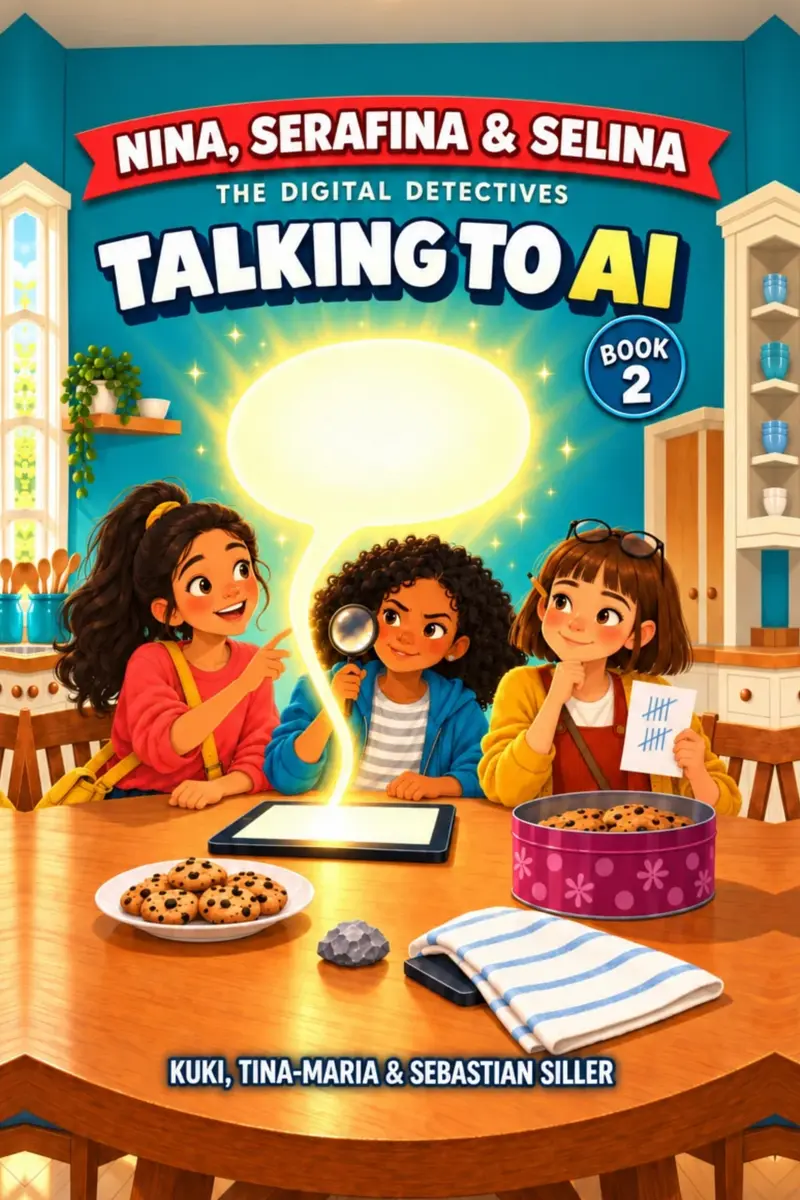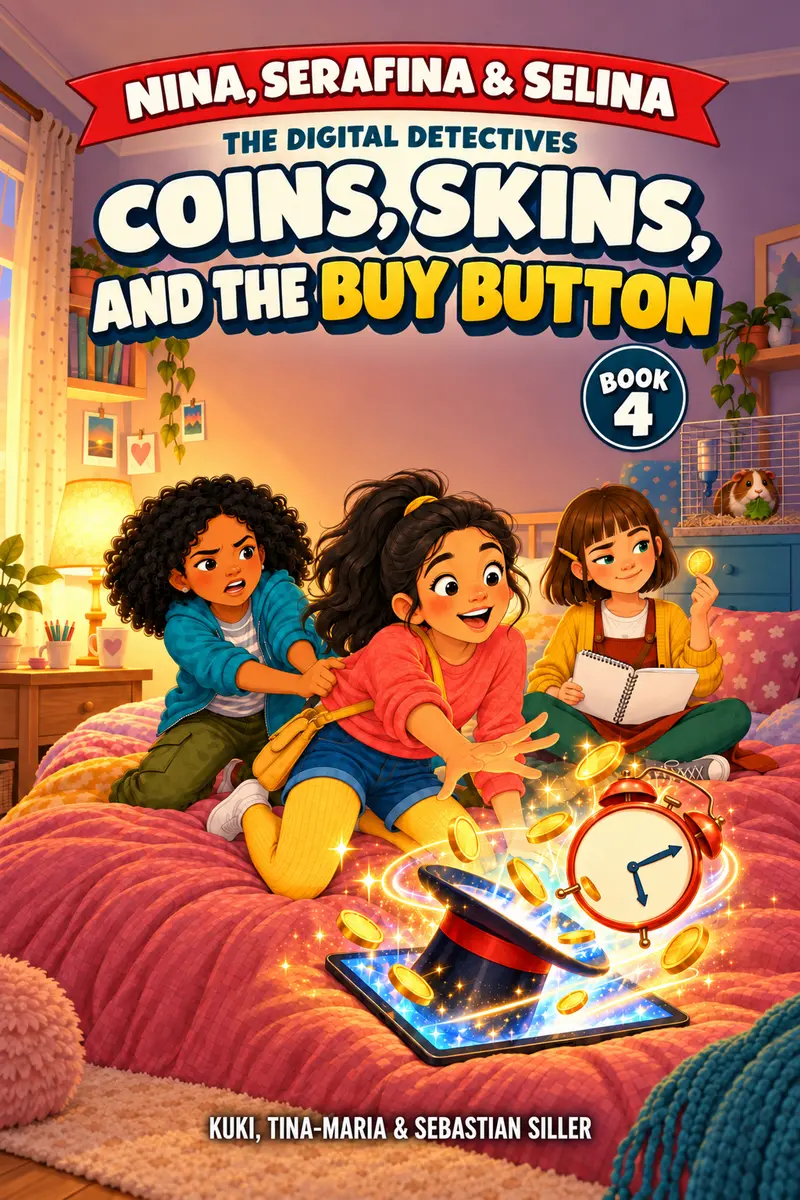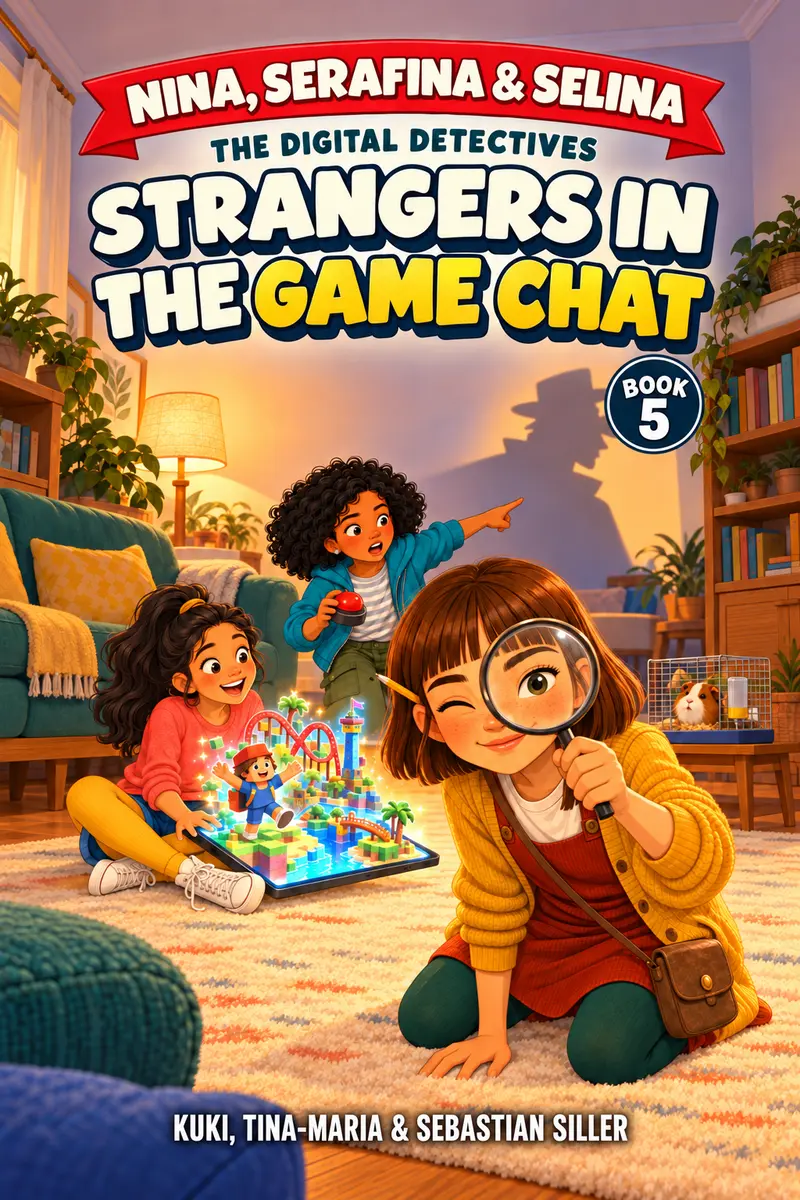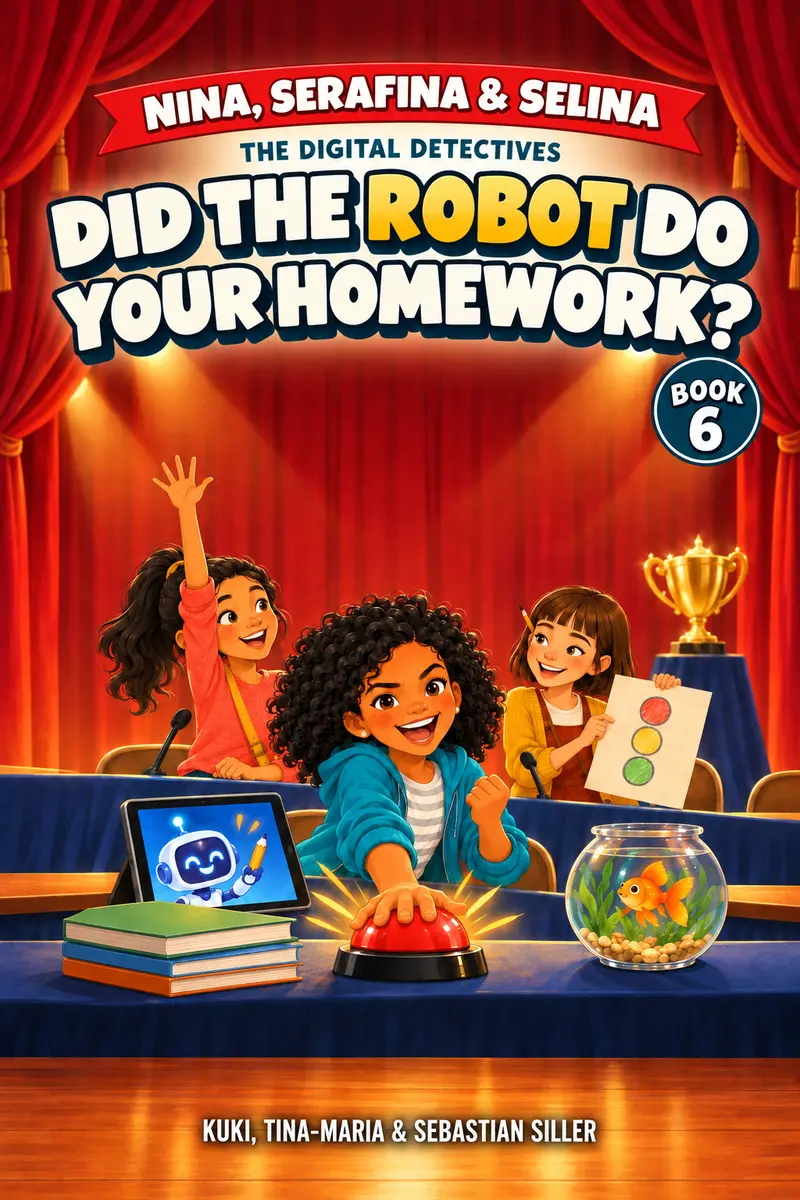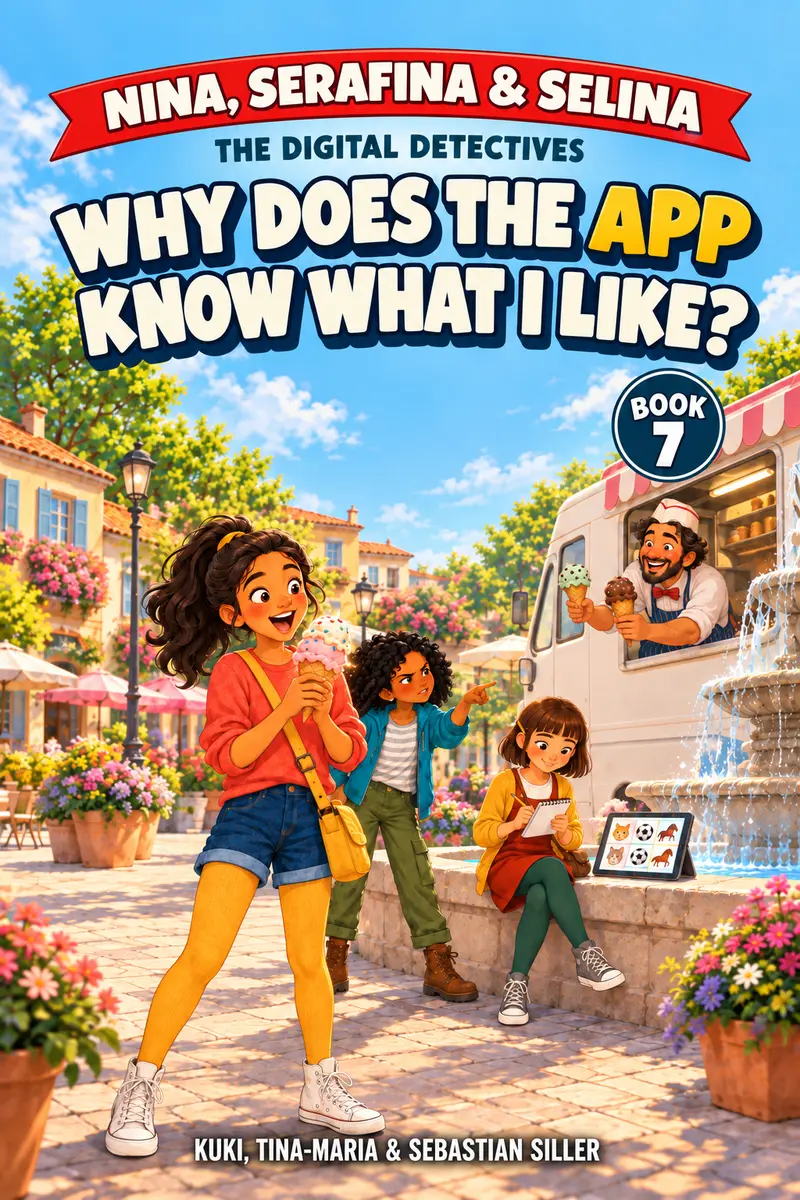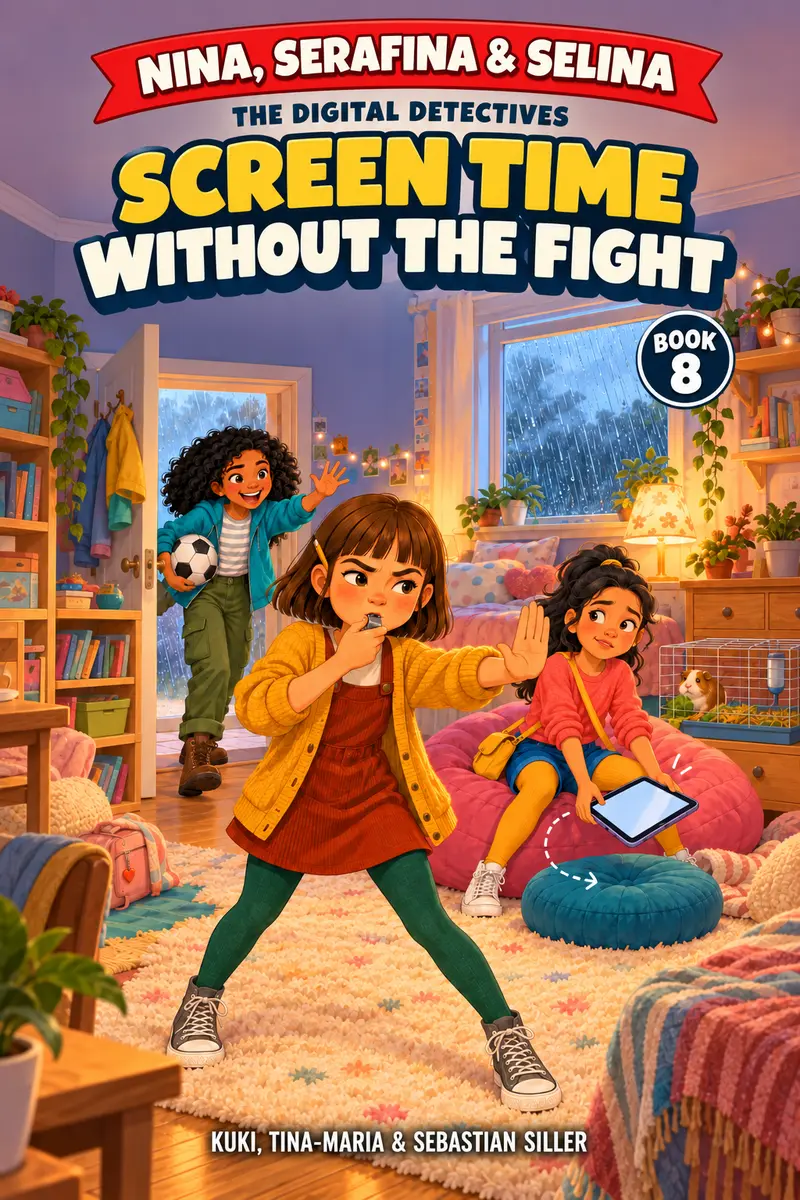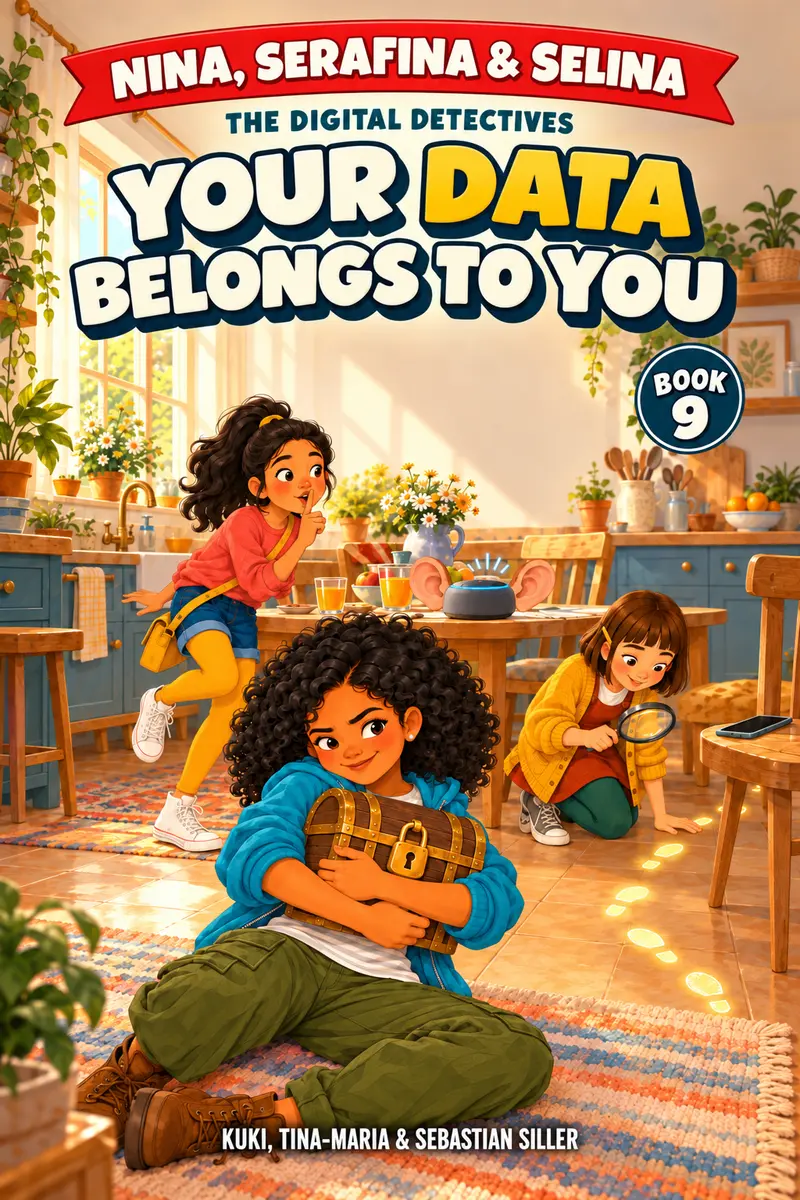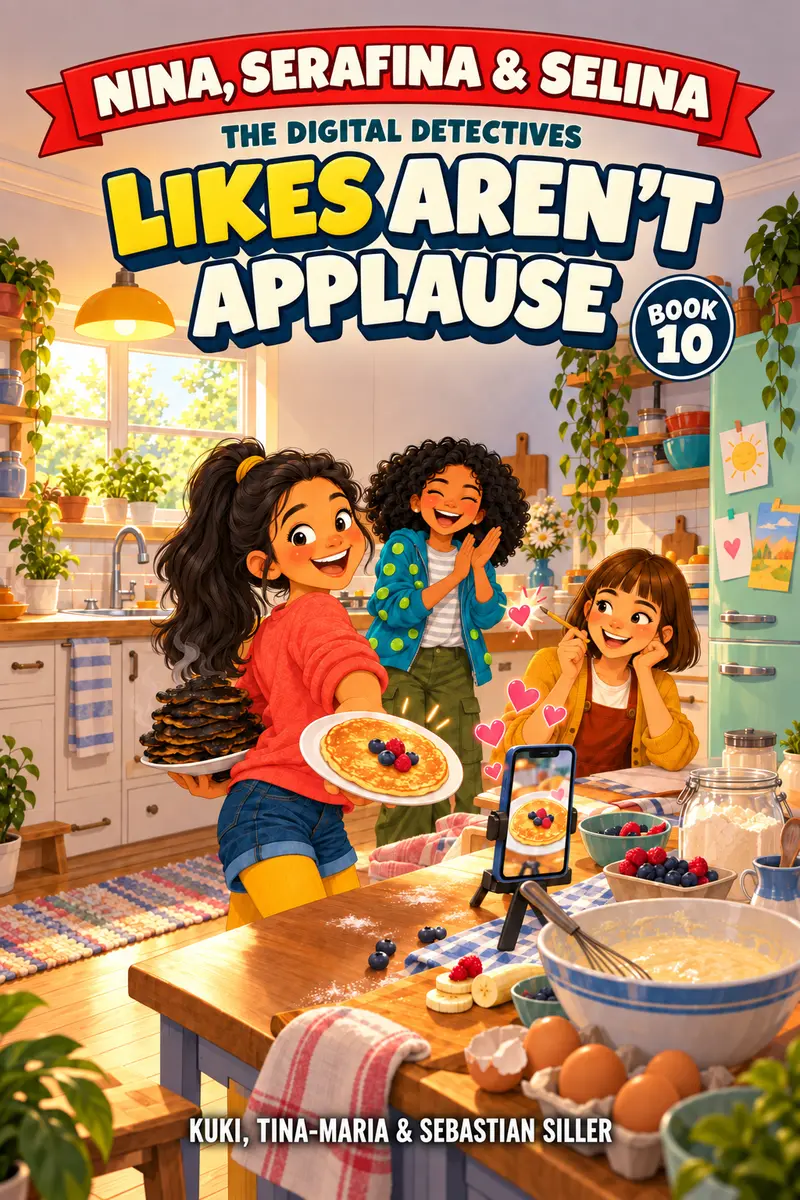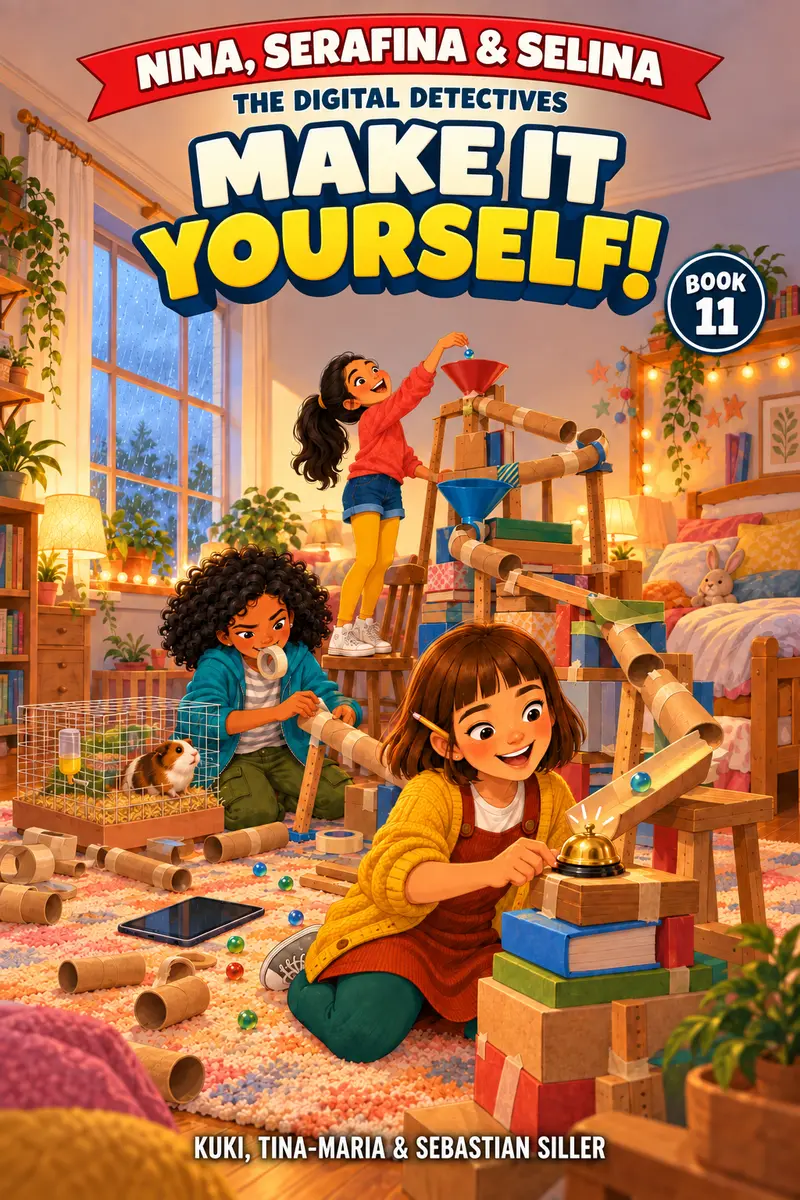
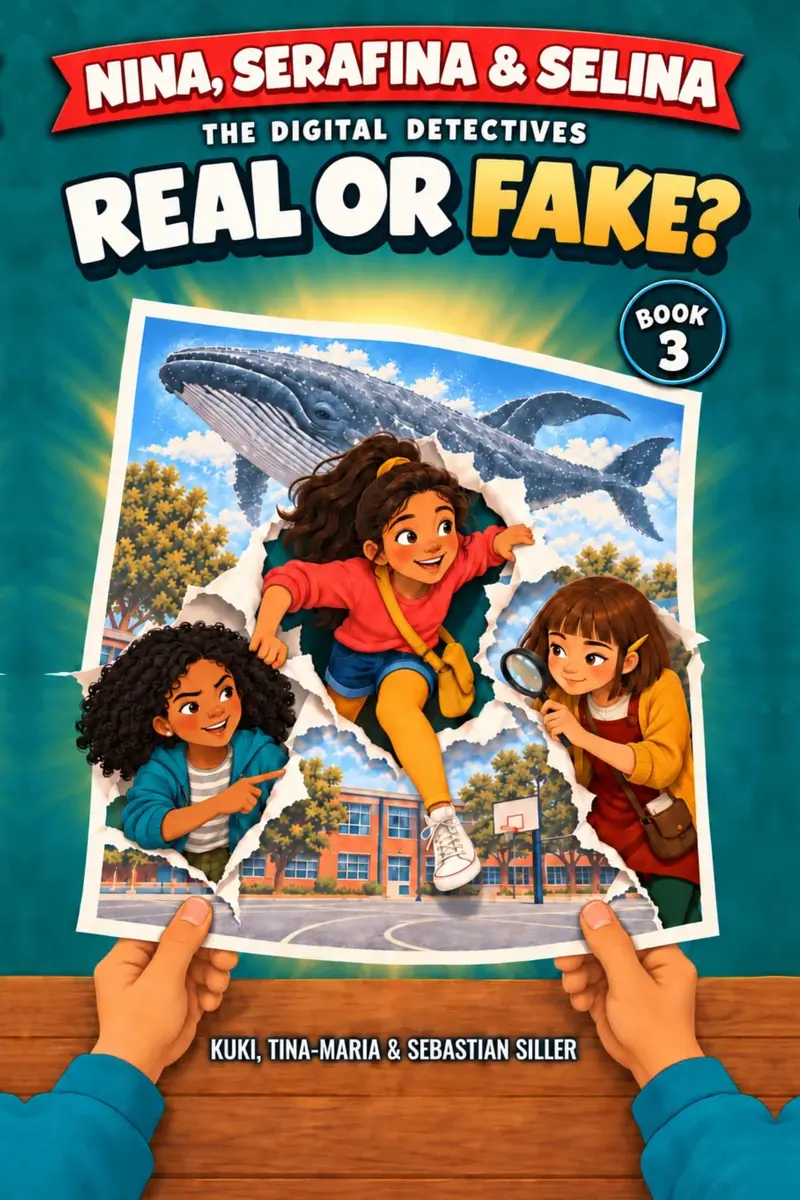
Book 3 of 11
Real or Fake?
Spotting Deepfakes and AI Pictures
ages 7–10
There’s a whale floating over the schoolyard. It already has twenty-three likes in the class chat.
Nina saw it first. Serafina says right away, “Hold on a second … wouldn’t we have noticed? We WERE there.” And Selina wants to know one thing before anyone forwards anything: Who’s showing us this?
That’s how the Digital Detectives’ third case begins. It leads them to a custodian’s cat that never existed, a soccer star and his supposed twenty pizzas, and a dog-sized squirrel on Grandma’s phone.
- The three questions that help you track down a fake
- The Feelings Alarm: why the WOW pictures are the ones to pause on
- “Real or Computed?” — why computed pictures are often too perfect
- An activity page that turns readers into picture detectives
The pictures keep getting better. This habit lasts: feel first, then check, then (maybe) share.
What the Detectives Crack
- 1“Looks real” and “is real” are two different things.
- 6A video is just a whisper too. Can be true. Can be computed.
- 11Believe it or don’t — the picture doesn’t decide. You’re the boss.
Show all
- 1“Looks real” and “is real” are two different things.
- 2A picture is a whisper. It can be true. It can be nonsense.
- 3Whoever forwards makes the fake bigger. Stopping is a superpower.
- 4Feel first, then check, then (maybe) share.
- 5The strongest check is a question, not a magnifying glass.
- 6A video is just a whisper too. Can be true. Can be computed.
- 7“The internet” is about as specific as “from somebody.”
- 8Believe everything and you get fooled. Believe nothing and you throw the truth away.
- 9The best eyes don’t win. The best questions win.
- 10Spotting fakes isn’t a talent. It’s like riding a bike.
- 11Believe it or don’t — the picture doesn’t decide. You’re the boss.
Keep Exploring
Real or Fake? — case closed.
“You always had to ask. We’ve just learned better questions.” — Nina, Chapter 11
Now you know: a picture can look completely real and still be computed. The best eyes don’t win. The best questions win: Who’s showing me this? Where did it come from originally? Do other people I trust say the same thing?
Remember: Believe it or don’t — the picture doesn’t decide. You’re the boss.
All eleven Remember lines on one poster — coming soon.
The Picture Detective Check
A picture makes you go WOW right away? That’s your Feelings Alarm. Feel first, then check, then (maybe) share. And for checking, you’ve got three questions — they fit every amazing picture and every video.
The printable version is coming soon. Until then, the Feelings Alarm and the three questions are on the activity page at the back of your book.
Become a Picture Detective!
All six activities from the book:
- The Feelings Alarm
- The three questions
- Real or Computed? — the game
- Build your own (obvious!) fake
- The ten-picture training
- The superpower
For “Build your own (obvious!) fake”: Ask a grown-up to compute the picture with you — “never with real people, never with a real photo, and without telling it your names, where you live, or which school you go to. ALWAYS write on it: ‘COMPUTED!’”
The big print-out version with room to write and draw is coming soon.
Activity Sheets to Print
The kids’ sheets: free, no sign-up. The book itself is available on Amazon.
- The Picture Detective CheckComing soon
- Activity PagesComing soon
- Pocket CardComing soon
- Remember PosterComing soon
- Teacher SheetComing soon
- Class SetComing soon
Want the sheets for the next book automatically? Get the parents’ post — optional, unsubscribe any time. Parents' post
For Parents
What your child learned about AI — and why it’s accurate
Modern AI chats do math: from billions of text examples, they predict which word most likely comes next. They don’t understand anything and have no consciousness and no feelings — yet they sound convincing. That’s why they can be helpful AND confidently wrong at the same time. Experts call these made-up answers “hallucinations.”
Two points matter most for kids:
- Data: What goes in may be stored and used. Kids should never share
their name, address, school, or secrets with an AI — the same rule as with strangers.
- Relationships: AI chatbots imitate friendliness perfectly. But they
are not a friend and not a therapist — only 18% of parents of teens are comfortable with their child seeking emotional support from AI (Pew Research Center, February 2026), and most parents’ skepticism is well founded. If your child tells an AI things they don’t tell you, that’s your signal to start a conversation.
And to be honest: even experts disagree about how risky the future of AI will be. This book deliberately stays with what your child can check and decide today.
Why this book matters right now
Half of 8- to 15-year-olds in Great Britain saw at least one deepfake within just six months — and at the same time, on average, children tell real from AI-made pictures and texts no better than chance (Ofcom 2024; Langer et al., Technology in Society 2026). Your child is already encountering fakes; the only question is whether they have tools for it. The good news: detection is learnable. In a British study with adults, just five minutes of training raised the hit rate for spotting AI-generated faces from 31% to 51% (Gray et al., 2025). It’s only a start — but it shows that checking is a skill anyone can practice.
One deliberate choice
This book intentionally does NOT rely on visual spotting tricks (“count the fingers”) — those go stale within months and create false confidence. Instead, it has kids practice what will still work in five years: find out where it came from, compare sources, ask someone who would know. And it doesn’t teach kids to distrust everything: the goal is “feel first, then check, then share” — not “trust nothing and no one.”
Keep the conversation going
Three questions for home: What do you like using AI for? When did you notice it can be wrong? What would you never tell it — and why?
“What’s the wildest thing you saw this week — and how do you decide whether it was real?” · “What would you do BEFORE forwarding a crazy picture to the group chat?” · Generate an obviously fake AI picture together (a house on the moon — described in words, no photo of your own) and test whether the relatives can tell — with a visible “COMPUTED!” label, of course.
Sources
All figures on the parents’ page come from these sources:
- Pew Research Center (February 2026): “How Teens Use and View AI” — survey of 1,458 U.S. parent–teen pairs, fielded fall 2025. Among other findings: only 18% of parents of teens are comfortable with their child seeking emotional support from AI. pewresearch.org/internet/2026/02/24/how-teens-use-and-view-ai/
- Ofcom (July 2024): “A deep dive into deepfakes that demean, defraud and disinform” — 1,000 children ages 8–15, Great Britain, fielded June 2024. 50% had seen at least one deepfake in the past six months. ofcom.org.uk/online-safety/illegal-and-harmful-content/deepfakes-demean-defraud-disinform
- Langer, Martinez, Marshall & Chein (2026): “Children’s susceptibility to content generated by artificial intelligence,” Technology in Society, vol. 86 — 37 children ages 6–10 and 49 adults, U.S. On average, children told AI-made pictures and texts from human-made ones no better than chance. doi.org/10.1016/j.techsoc.2026.103303
- Gray, Davis, Bunce, Noyes & Ritchie (November 2025): “Training human super-recognizers’ detection and discrimination of AI-generated faces,” Royal Society Open Science 12(11) — 664 adults, UK. Trained participants spotted AI faces 51% of the time versus 31%. doi.org/10.1098/rsos.250921
A parents’ guide in English is coming soon.
For Schools
A teacher sheet for one lesson on real and fake pictures — goal, a 45-minute plan, answers, and questions for discussion — plus a class set of the activity pages. In English: coming soon.