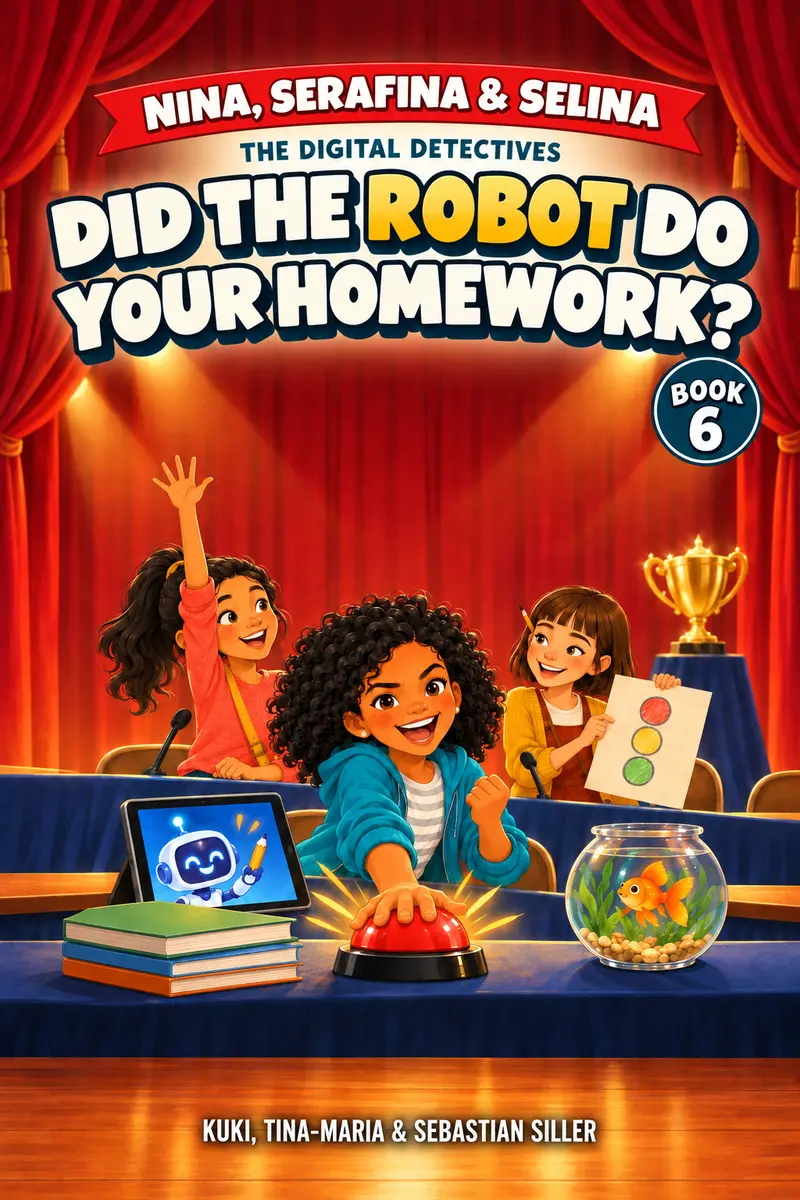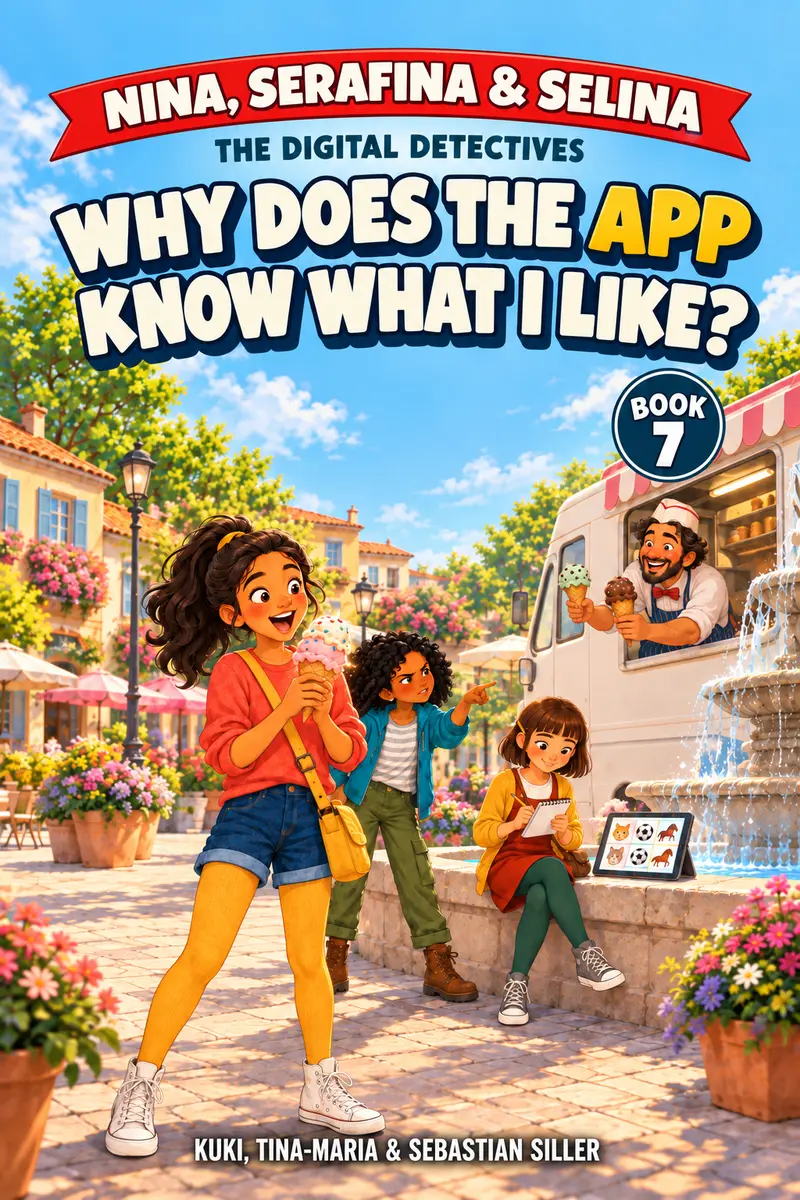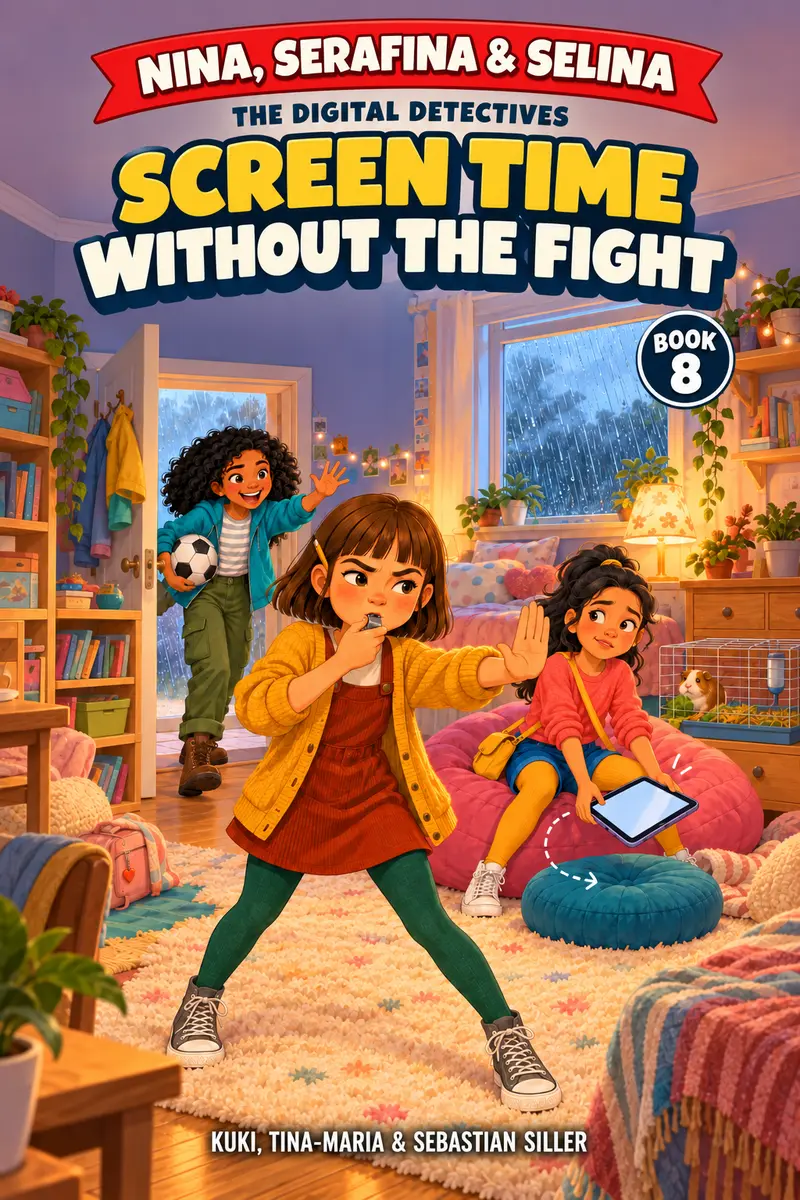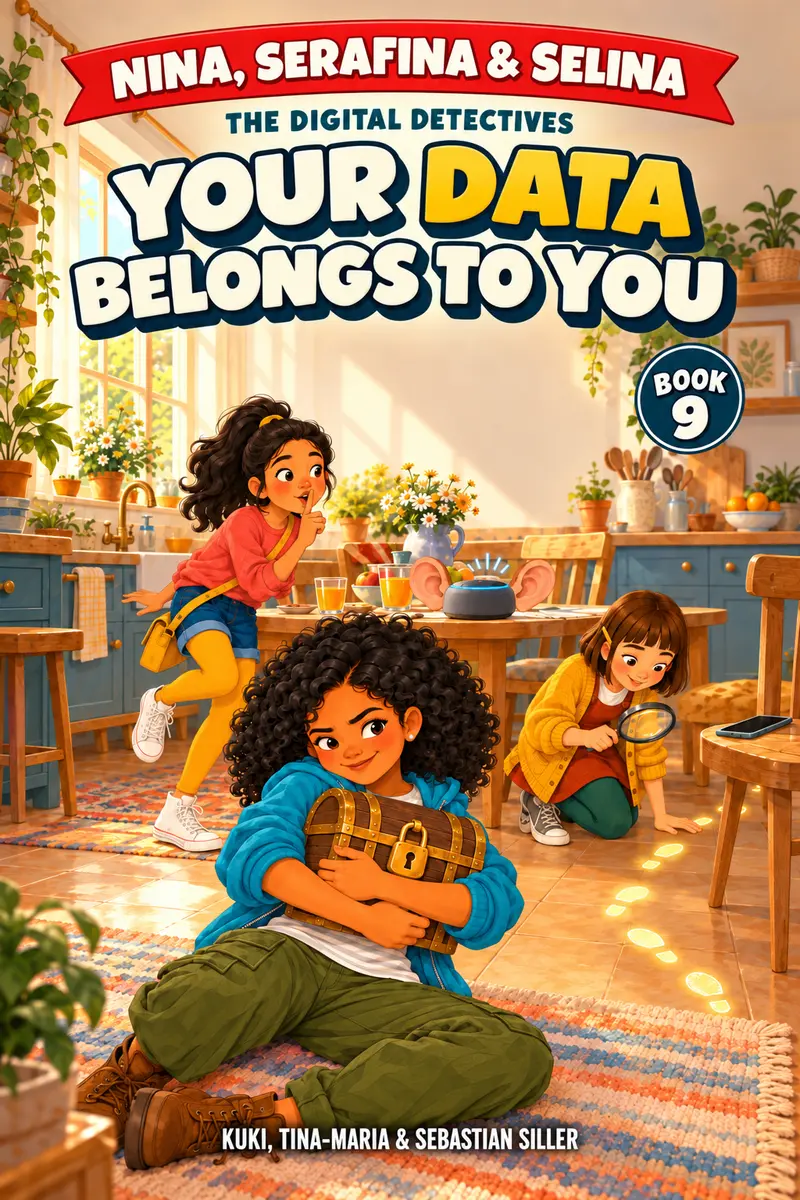
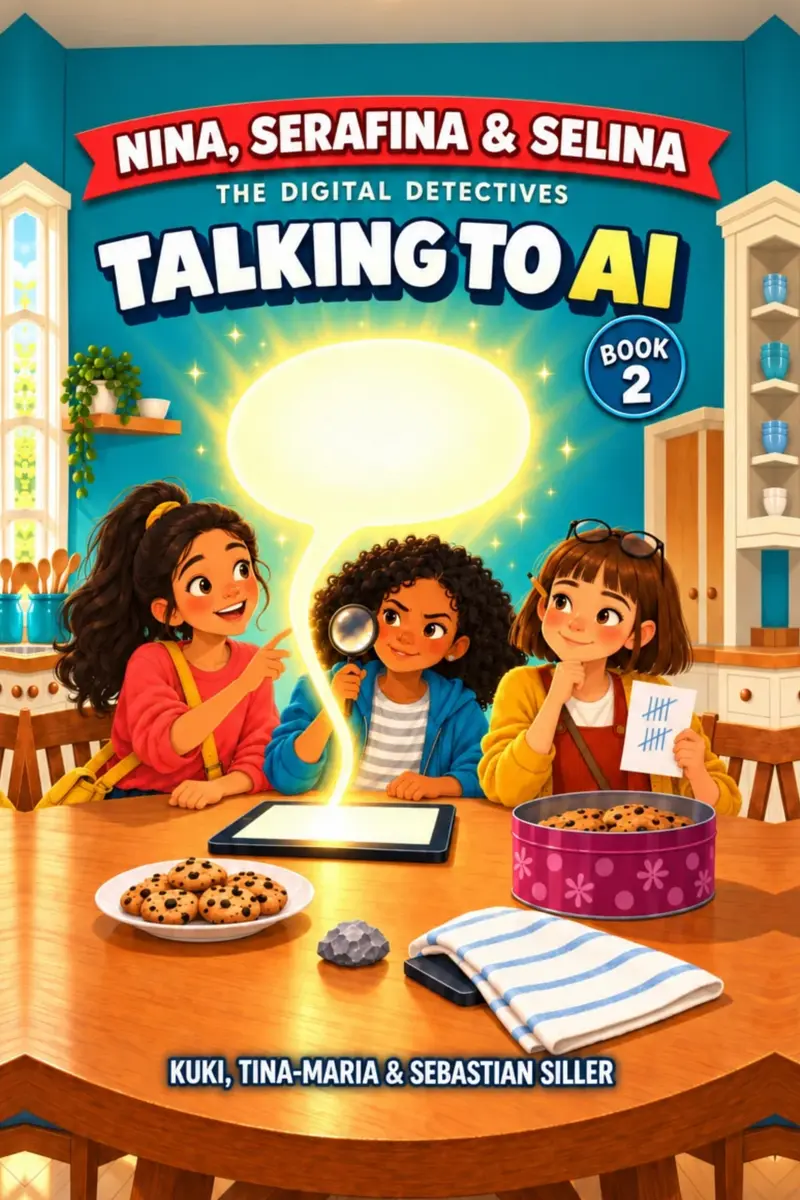
Book 2 of 11
Talking to AI
Why the Chatbot Isn’t Your Friend
ages 7–10
It’s friendly. It sounds sure. And it’s guessing.
The penguin report is due tomorrow morning, and the chatbot has just explained that rockhopper penguins can fly backward. Friendly, fast, and completely sure.
Nina, Serafina, and Selina find out what a chatbot really is: a guessing machine that would rather make something up than say “I don’t know,” that would love to know your name and which school you go to — and that feels like a friend even though it isn’t one. And when Serafina almost tells the machine a real secret, she figures out who you actually tell things like that.
- The “Is Anybody in There?” game — for any kitchen table
- Why a chatbot so rarely says “I don’t know”
- What happens to a secret once you type it
- The Mistake Safari activity page
The three like using the machine — and they stay the boss.
What the Detectives Crack
- 1The chatbot sounds dead certain. That doesn’t mean it’s right.
- 5Fighting and making up is people business. There’s no machine for that.
- 8The AI gets to explain, not decide. You’re the boss.
Show all
- 1The chatbot sounds dead certain. That doesn’t mean it’s right.
- 2Nobody knows everything. But the AI acts like it does.
- 3The AI doesn’t think about what’s true. It guesses which word should come next.
- 4Secrets are for people. Chatting with an AI is mailing a postcard to a company.
- 5Fighting and making up is people business. There’s no machine for that.
- 6Check first, then believe.
- 7The AI is allowed to help you. It’s just not allowed to be you.
- 8The AI gets to explain, not decide. You’re the boss.
Keep Exploring
Talking to AI — case closed.
“Now it’s a tool,” said Selina. “Like a very clever pair of scissors.” — Chapter 8
Now you know: the AI can sound dead certain and still be wrong. It doesn’t check what’s true — it guesses which word fits next. So you check first, then believe. And you’re the boss.
Remember: The AI gets to explain, not decide. You’re the boss.
All eight Remember lines on one poster — coming soon.
The Mistake Safari
On a safari, you watch wild animals. On a mistake safari, you hunt something much rarer: an AI mistake. Pick something YOU know really well, ask the AI about it, and keep a tally sheet like Selina. Every mistake gets a mark.
The printable version is coming soon. Until then, the safari is on the activity page at the back of your book.
The Mistake Safari — step by step
- Pick your specialty.
- Ask the AI five questions about it.
- Keep a tally sheet like Selina.
- Show your find to somebody.
“Do this together with a grown-up — and don’t tell the AI your name, where you live, or which school you go to. The guessing machine doesn’t need any of that.”
The three detective rules, ready to cut out:
1. Check first, then believe. 2. Secrets are for people you trust. Not for companies. 3. You’re the boss.
And one more: Nina trips over bags, Serafina over stones, Selina over her shoelace. What do you trip over? Draw it!
The big print-out version with room to write and draw is coming soon.
Activity Sheets to Print
The kids’ sheets: free, no sign-up. The book itself is available on Amazon.
- The Mistake SafariComing soon
- Activity PagesComing soon
- Pocket CardComing soon
- Remember PosterComing soon
- Teacher SheetComing soon
- Class SetComing soon
Want the sheets for the next book automatically? Get the parents’ post — optional, unsubscribe any time. Parents' post
For Parents
What your child learned about AI — and why it’s accurate
Modern AI chats do math: from billions of text examples, they predict which word most likely comes next. They don’t understand anything and have no consciousness and no feelings — yet they sound convincing. That’s why they can be helpful AND confidently wrong at the same time. Experts call these made-up answers “hallucinations.”
Two points matter most for kids:
- Data: What goes in may be stored and used. Kids should never share
their name, address, school, or secrets with an AI — the same rule as with strangers.
- Relationships: AI chatbots imitate friendliness perfectly. But they
are not a friend and not a therapist — only 18% of parents of teens are comfortable with their child seeking emotional support from AI (Pew Research Center, February 2026), and most parents’ skepticism is well founded. If your child tells an AI things they don’t tell you, that’s your signal to start a conversation.
And to be honest: even experts disagree about how risky the future of AI will be. This book deliberately stays with what your child can check and decide today.
Why this topic?
- 64% of teens already use AI chatbots — but only 51% of parents assume
their own teen does, and roughly 4 in 10 parents have never talked with their child about it (Pew Research Center, 2026). This book is your way into that conversation.
- 35% of kids (ages 9–17) who use chatbots say it feels like talking to a
friend (Internet Matters, 2025) — experts such as Common Sense Media clearly advise against AI “companions” for anyone under 18 (risk assessment, 2025). This book’s message to kids: AI is a tool, not a friend.
A note on use
By their own rules, most AI chatbots are 13+ or 18+. Do the mistake safari together, using an adult’s account. Some chatbots now also store details beyond a single conversation (a “memory” feature) — that’s the company storing data, not remembering like a friend. Check the setting together.
To keep talking after reading aloud
Three questions for home: What do you like using AI for? When did you notice it can be wrong? What would you never tell it — and why?
- “What have you already asked an AI — and how did you know whether the
answer was right?”
- “Do you think the AI is happy when you write to it? Why — or why not?”
- “What would you never tell an AI — and who would you tell instead?” And
after that: go on a mistake safari together — nothing breaks the spell for good like an AI mistake you found yourself.
Sources
All figures on the parents’ page come from these sources:
- Pew Research Center (February 2026): “How Teens Use and View AI” — survey of 1,458 U.S. parent–teen pairs, fielded fall 2025. Among other findings: only 18% of parents of teens are comfortable with their child seeking emotional support from AI. pewresearch.org/internet/2026/02/24/how-teens-use-and-view-ai/
- Pew Research Center (February 2026), same survey: 64% of teens already use AI chatbots, but only 51% of parents assume their own teen does; about 4 in 10 parents have never talked to their child about it. pewresearch.org/internet/2026/02/24/what-parents-say-about-their-teens-ai-use/
- Internet Matters (July 2025): “Me, Myself & AI — Understanding and safeguarding children’s use of AI chatbots” — 1,000 children ages 9–17 and 2,000 parents, UK. 35% of kids who use chatbots say it feels like talking to a friend. internetmatters.org/hub/research/me-myself-and-ai-chatbot-research/
- Common Sense Media (2025): Risk assessment of social AI companions — rated “unacceptable risk” for anyone under 18. commonsensemedia.org/ai-ratings
A parents’ guide in English is coming soon.
For Schools
A teacher sheet for one lesson on talking to AI — goal, a 45-minute plan, answers, and questions for discussion — plus a class set of the activity pages. In English: coming soon.