Book 1 of 11
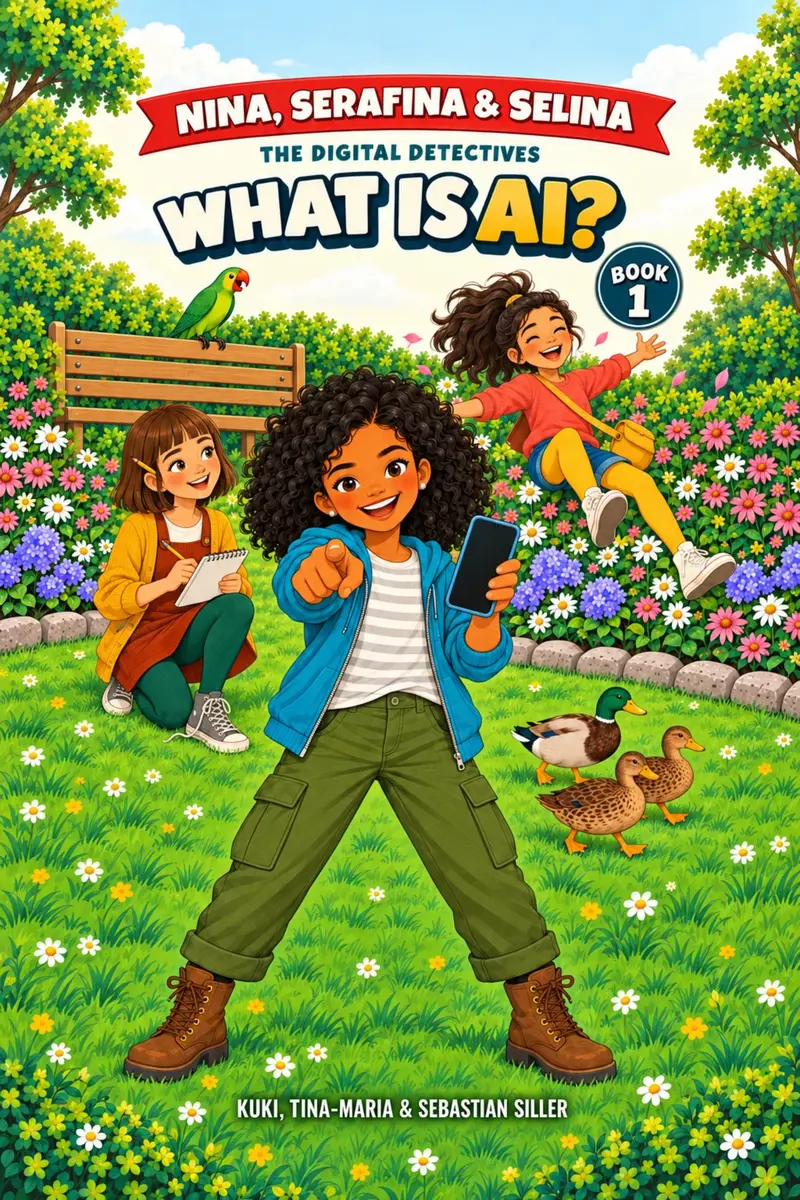
What Is AI?
Meet the Guessing Machine
ages 7–10
ISBN: Hardcover 978-3-903752-03-0 · Paperback 978-3-903752-04-7 · eBook 978-3-903752-05-4
Where to buy
Is AI really smarter than all the teachers put together?
Tobias is sure of it. Nina asks, “How do you know?” Serafina doesn’t believe a word of it. And Selina notices something odd about the word “intelligence” on the board.
So the three put it to the test. They play guessing machine themselves, go on an AI scavenger hunt, and listen to Serafina’s grandma tell the story of a parrot who talked beautifully and understood nothing. By the end, they know what AI really is: a guessing machine. Amazingly good — and still sometimes way off.
- Why AI guesses instead of knowing
- Where AI hides in everyday things
- The zibblet test: how a machine learns from examples
- Why something can sound smart and still be wrong
Afterward, kids know how the guessing machine guesses — and can tell for themselves when it gets it wrong.
What the Detectives Crack
- 1The AI is fast. But that doesn’t tell you if it’s right.
- 7If it can be wrong, it’s probably a guessing machine.
- 12AI isn’t a friend, an enemy, or magic — it’s a tool. You’re the boss.
Show all
- 1The AI is fast. But that doesn’t tell you if it’s right.
- 2Don’t look for AI by its looks. Look for what it does.
- 3The AI only guesses the next word — and sounds smarter than it is.
- 4An AI is only as good or as bad as what it was shown.
- 5AI pictures and voices seem real but are made up. Checking shows what’s real.
- 6Inside the AI there’s no person and no magic — just math.
- 7If it can be wrong, it’s probably a guessing machine.
- 8The AI finds words for a hug. But only a person can really hug you.
- 9Like a parrot, the AI says what you want to hear — not what’s true.
- 10Check first, then believe — especially when it sounds smart.
- 11An AI wants nothing. It does what we want — as long as we pay attention.
- 12AI isn’t a friend, an enemy, or magic — it’s a tool. You’re the boss.
Keep Exploring
What Is AI? — case closed.
“It’s a tool. A strong one. But the boss is still you.” — Selina, Chapter 12
Now you know something lots of grown-ups don’t: AI is a guessing machine. It has seen millions of examples and guesses what comes next. Usually well. Sometimes total nonsense. And you’re the boss.
Remember: AI isn’t a friend, an enemy, or magic — it’s a tool. You’re the boss.
All twelve Remember lines on one poster — coming soon.
The Zibblet Test
Selina made up the zibblets — chubby, spiky ears, curly tail. You see three examples, then a new animal: does it belong? Nobody told you the rule. But you know anyway. That’s exactly how the machine learns.
The printable version is coming soon. Until then, you’ll find the test on the activity page at the back of your book (number 2) — grab a pencil, draw three zibblets, and test somebody.
Become an AI Researcher Yourself!
All five activities from the book:
- The umbrella-dog sentence
- The zibblet test
- AI or not AI? — Hint from the book: whatever can be wrong is usually an AI.
- The AI scavenger hunt
- Catch the parrot
For “Catch the parrot”: Together with a grown-up, ask an AI a question YOU know the answer to for sure — “but never tell it your name, where you live, or which school you go to!”
The big print-out version with room to write and draw is coming soon.
Activity Sheets to Print
The kids’ sheets: free, no sign-up. The book itself is available on Amazon.
- The Zibblet TestComing soon
- Activity PagesComing soon
- Pocket CardDownload
- Remember PosterDownload
- Teacher SheetComing soon
- Class SetComing soon
Want the sheets for the next book automatically? Get the parents’ post — optional, unsubscribe any time. Parents' post
For Parents
What your child learned about AI — and why it’s accurate
Modern AI chats do math: from billions of text examples, they predict which word most likely comes next. They don’t understand anything and have no consciousness and no feelings — yet they sound convincing. That’s why they can be helpful AND confidently wrong at the same time. Experts call these made-up answers “hallucinations.”
Two points matter most for kids:
- Data: What goes in may be stored and used. Kids should never share
their name, address, school, or secrets with an AI — the same rule as with strangers.
- Relationships: AI chatbots imitate friendliness perfectly. But they
are not a friend and not a therapist — only 18% of parents of teens are comfortable with their child seeking emotional support from AI (Pew Research Center, February 2026), and most parents’ skepticism is well founded. If your child tells an AI things they don’t tell you, that’s your signal to start a conversation.
And to be honest: even experts disagree about how risky the future of AI will be. This book deliberately stays with what your child can check and decide today.
Why a whole book about the basics?
Kids use AI long before they understand what it is — 62% of students from middle school through college already use it for homework (RAND Corporation, survey December 2025), and it sits inside translators, cameras, recommendations, and voice assistants. Once a child has grasped the core principle — pattern-guessing from examples, not thinking — they see through fakes, recommendation feeds, and data collection largely on their own. That’s exactly what the following books build on. Recognized U.S. school curricula for AI — such as AI4K12 and the MIT program “Day of AI” — count exactly this core principle, that computers learn from data by finding patterns in examples, among the key ideas every child should understand about AI.
A word on balance
This book doesn’t paint AI as a villain or as magic. It shows it as what it is — a powerful tool that brings real benefits (languages, reading aloud, medicine) and can be confidently wrong at the same time. The book also takes the “robot uprising” fear seriously and puts it in perspective: an AI has no will of its own; what matters is what people do with the tool. The goal isn’t fear, and it isn’t distrusting everything. It’s a simple habit: check before you believe — and before you dismiss.
A note on use
By their own rules, most AI chatbots are 13+ or 18+. Try the activity-page tasks together, using an adult’s account — that way a grown-up is always right there with them.
Keep the conversation going
Three questions for home: What do you like using AI for? When did you notice it can be wrong? What would you never tell it — and why?
“Where did you run into AI today without noticing?” · “How would you explain to a younger kid that the AI is not their friend?” · Play “guessing machine” together — in two minutes it shows how a chain of perfectly plausible words turns into convincing nonsense.
Sources
All figures on the parents’ page come from these sources:
- Pew Research Center (February 2026): “How Teens Use and View AI” — survey of 1,458 U.S. parent–teen pairs, fielded fall 2025. Among other findings: only 18% of parents of teens are comfortable with their child seeking emotional support from AI. pewresearch.org/internet/2026/02/24/how-teens-use-and-view-ai/
- RAND Corporation (March 2026): “More Students Use AI for Homework, and More Believe It Harms Critical Thinking” (RR-A4742-1) — American Youth Panel, 1,214 youth ages 12–29, U.S., fielded December 2025. AI use for homework rose from 48% (May 2025) to 62%. rand.org/pubs/research_reports/RRA4742-1.html
- AI4K12 (AAAI/CSTA, 2019): “Five Big Ideas in Artificial Intelligence” — U.S. guidelines for what every K–12 student should know about AI; Big Idea 3: computers can learn from data. ai4k12.org
- Day of AI (MIT RAISE, since 2021): AI-literacy curriculum starting in elementary school — kids learn that computers look for patterns in examples and make predictions from them. dayofai.org
A parents’ guide in English is coming soon.
For Schools
A teacher sheet for one lesson on “What is AI?” — goal, a 45-minute plan, answers, and questions for discussion — plus a class set of the activity pages. In English: coming soon.